
Introduction
Green cleaning is no longer optional. In 2026, regulatory frameworks across North America, Europe, and increasingly Asia-Pacific have made eco-compliance a hard requirement for any organization running commercial cleaning operations.
Facility managers, cleaning contractors, and procurement teams are now evaluated on the environmental performance of their equipment — not just their cleaning results. That means every commercial vacuum cleaner, industrial floor cleaning machine, and piece of industrial cleaning equipment in your facility needs to meet a rising bar of standards.
Cleaning equipment manufacturers are responding. They're redesigning motors, filtration systems, materials, and water management to align with these frameworks. This article explains what's changing, why it matters, and how to make purchasing decisions that keep you compliant now and ahead of the curve later.
What "Green Cleaning Regulations" Mean for Equipment
Green cleaning regulations aren't a single rulebook. They're a set of overlapping standards and policies that together cover energy use, emissions, chemical safety, filtration performance, and packaging.
Energy-efficiency and eco-design rules govern the power draw of electrical appliances. For a commercial vacuum cleaner or industrial floor cleaning machine, this typically means motor wattage limits and mandatory efficiency ratings. Manufacturers must now engineer for performance within stricter power envelopes.
Indoor air quality and low-emission requirements apply directly to how a machine handles dust, allergens, and particulate matter. A vacuum that redistributes fine particles back into the air isn't just ineffective — in hospitals, schools, and offices, it's a liability.
Certification programs like the CRI (Carpet and Rug Institute) Green Label and Seal of Approval exist specifically for commercial vacuums. They verify that a machine meets defined thresholds for soil removal, dust containment, and carpet appearance retention. Independent testing, not manufacturer claims, backs these certifications.
Green public procurement policies - government and institutional purchasing guidelines - increasingly require that industrial cleaning - equipment meet eco-label criteria before it can be considered in tenders. For cleaning contractors, this is now a competitive prerequisite, not a differentiator.
Packaging restrictions round out the picture. Many jurisdictions now limit single-use plastics and excess packaging, which affects how replacement parts and consumables for cleaning machines are supplied.
How Cleaning Equipment Manufacturers Are Adapting
The short answer: they're engineering compliance in from the start. Here's what that looks like across four key areas.
Energy-Efficient Motors and Smarter Power Management
Modern industrial cleaning equipment increasingly uses brushless digital motors that deliver higher airflow at lower wattage. These motors operate more efficiently across variable load conditions, which directly reduces energy consumption per cleaning cycle.
Smart power modes - automatic suction adjustment based on surface type, for example — also help machines stay within regulatory thresholds without sacrificing performance. For facility managers, this translates to lower electricity bills and a credible energy reduction story for sustainability reporting.
Filtration, Indoor Air Quality, and Health
The shift to multi-stage HEPA-level filtration in commercial vacuums is one of the most significant design changes of the past few years. HEPA filtration (High Efficiency Particulate Air) captures 99.97% of particles at 0.3 microns - fine dust, allergens, and airborne pathogens that standard filters miss.
Cleaning equipment manufacturers pursuing CRI Green Label certification must demonstrate these filtration standards through independent lab testing. This matters most in high-sensitivity environments: hospitals managing infection control, schools protecting children with respiratory conditions, offices aiming to meet indoor air quality benchmarks.
Sustainable Materials and Design for Recycling
Industrial cleaning equipment is getting redesigned for end-of-life, not just point-of-sale. Manufacturers are replacing mixed-material assemblies with single-polymer components that can be recycled without disassembly.
Modular design is also gaining ground. Machines built with replaceable, standardized modules — motors, brush heads, tanks — last longer and generate less waste. This supports circular economy goals and reduces the total lifecycle environmental impact of the equipment.
Water and Chemical Reduction in Floor Machines
Today's industrial floor cleaning machine is engineered to do more with less. Low-flow scrubbing systems reduce water consumption significantly compared to machines from five years ago. Chemical dosing controls prevent overuse and ensure consistent dilution ratios, which cuts both cost and chemical runoff.
Some models now support chemical-free cleaning options — using electrochemically activated water, for example — which align directly with green procurement requirements and reduce residue on floor surfaces. Safer floors, lower chemical costs, and a cleaner environmental record: these aren't trade-offs anymore.
Choosing the Best Commercial Vacuum Cleaner and Floor Machines in 2026
Here's a practical framework for buyers making decisions under current green standards.
For a commercial vacuum cleaner, look for:
An energy-efficiency rating or eco-label that reflects compliance with local appliance standards
CRI Green Label or equivalent independent certification for filtration and soil removal
HEPA filtration with a sealed system (so air doesn't bypass the filter)
Noise ratings below 70 dB for use in occupied spaces
Confirmed availability of spare parts and a clear manufacturer service commitment
The best commercial vacuum cleaner for a regulated environment isn't necessarily the most powerful one. It's the one with verified performance, documented certifications, and a realistic total cost of ownership over five or more years.
For an industrial floor cleaning machine, evaluate:
Water and chemical consumption per square meter of cleaned surface
Battery efficiency and runtime — key for large facilities where recharging mid-shift wastes time
Ergonomic design features that reduce operator fatigue and injury risk
Telematics or connectivity options that track usage data, helping you optimize cleaning routes and report on sustainability metrics
Compliant equipment also helps you meet internal sustainability KPIs and strengthens your position in green procurement tenders.
What This Means for Cleaning Contractors and Facilities
Running compliant equipment isn't just about avoiding regulatory risk. It's a direct business advantage.
Cleaning contractors who use certified industrial cleaning equipment win more bids. Public sector and corporate clients are now embedding green equipment requirements into RFPs — and they check. Showing up with documented, certified machines signals professionalism and commitment.
For facility managers, the math is straightforward. The upfront cost of eco-designed equipment is often slightly higher. The total cost of ownership — lower energy bills, fewer consumables, longer machine life, reduced maintenance — regularly makes it the cheaper option over time.
Work with cleaning equipment manufacturers who are transparent about their compliance roadmap. Regulations are tightening. Manufacturers who are ahead of the curve now will help you avoid forced replacements later.
Conclusion
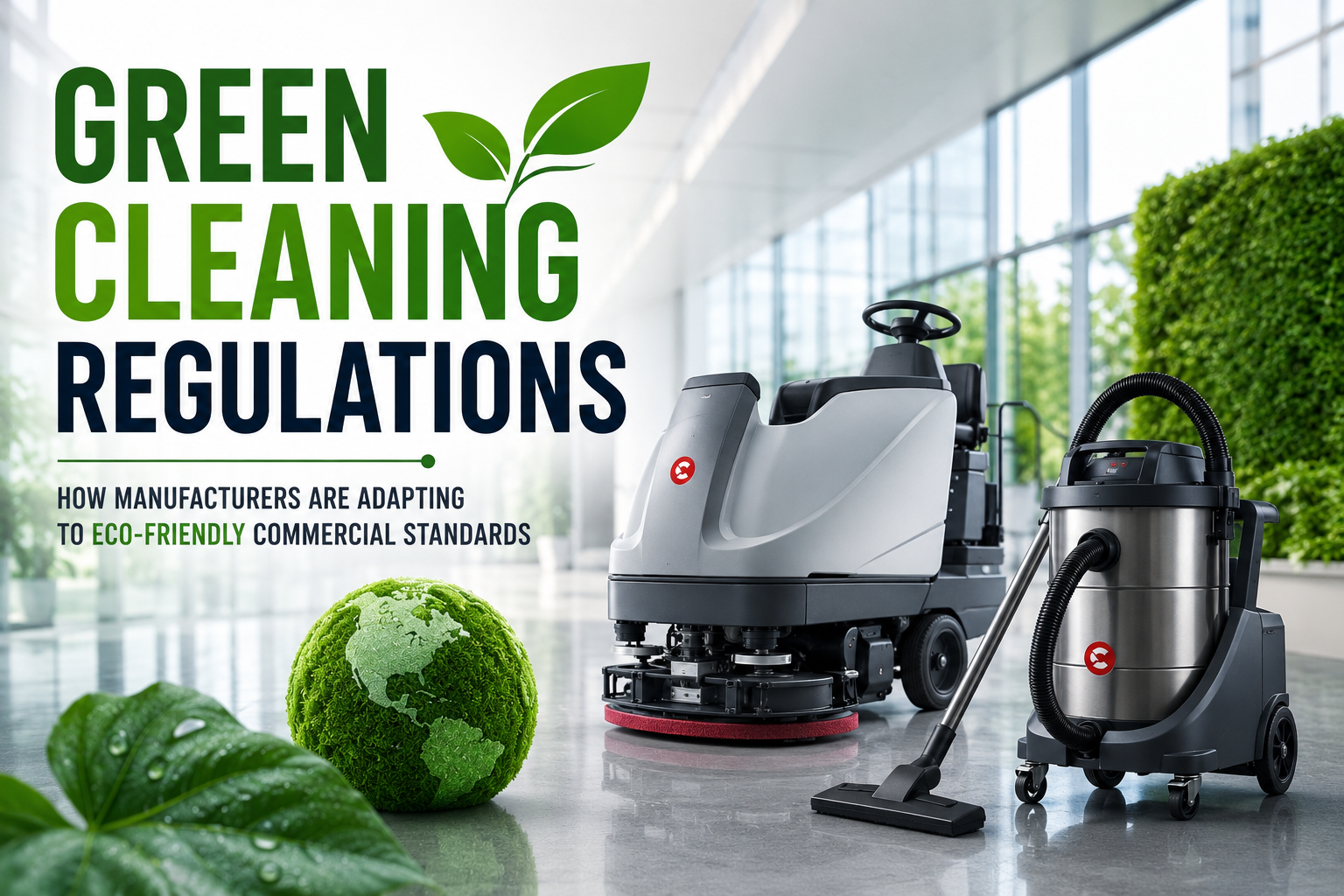
Green cleaning regulations are actively reshaping how every commercial vacuum cleaner and piece of industrial cleaning equipment is built, tested, and sold. This isn't a trend — it's the new baseline.
Make purchases that account for certification, lifecycle impact, and total cost. Partner with cleaning equipment manufacturers who treat compliance as a design requirement, not an afterthought. Future-proof decisions made today will save you money, protect your contracts, and hold up against whatever regulation comes next.
FAQ: Green Cleaning Regulations and Commercial Equipment
1. What makes a commercial vacuum cleaner "green" or eco-friendly in 2026?
A green commercial vacuum cleaner meets energy-efficiency standards for power draw, uses HEPA-level filtration to contain dust and allergens, and holds independent certification — such as CRI Green Label — for soil removal and low dust emissions. Machines built with recyclable materials and modular, repairable components score higher on lifecycle assessments.
2. How do green cleaning regulations affect the best commercial vacuum cleaner for my facility?
Regulations set minimum thresholds for filtration performance, energy consumption, and emissions. The best commercial vacuum cleaner for your facility is one that meets or exceeds these thresholds with documented proof — not just manufacturer marketing. Certification from an independent body is the clearest signal.
3. What should I look for in an industrial floor cleaning machine to comply with eco-friendly standards?
Focus on water consumption per cleaned area, chemical dosing controls, and battery efficiency. An industrial floor cleaning machine designed for green compliance will also have low chemical residue output and may support chemical-free cleaning modes. Check whether the machine qualifies under your local or institutional green procurement criteria.
4. Are eco-designed industrial cleaning equipment models more expensive to run?
Typically, no. Eco-designed industrial cleaning equipment uses less energy, less water, and fewer chemicals per cleaning cycle. The upfront price may be slightly higher, but lower operating costs and longer machine lifespan make total cost of ownership lower in most cases.
5. How are cleaning equipment manufacturers reducing emissions and improving indoor air quality?
Cleaning equipment manufacturers are switching to brushless motors with lower power draw, building sealed multi-stage filtration systems that prevent particle bypass, and designing machines that generate less noise and airborne particulate during operation. These changes are increasingly driven by certification requirements and green procurement mandates.
6. How often should I upgrade my commercial vacuum cleaner or industrial floor cleaning machine to stay compliant with new regulations?
There's no fixed answer, but a practical rule is to review your equipment every four to six years against current certification standards and energy ratings. If a machine no longer qualifies for the certifications required by your clients or procurement policies, that's a clear signal to upgrade. Working directly with cleaning equipment manufacturers helps you track upcoming regulatory changes before they become urgent.
Write a comment ...